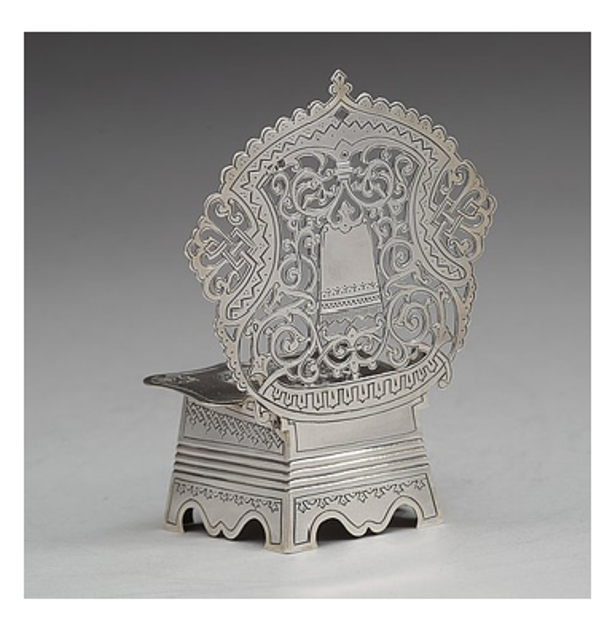
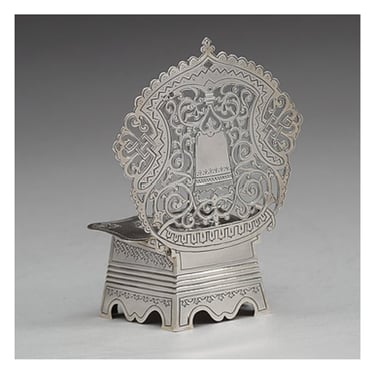
This is report is an analysis of the artifact labeled Object #3, which was discovered in the region of the United States of America known as the Carolinas, and is dated sometime before the Great Apocalypse of 2030. It is an object of small dimensions, measuring 13.5 cm by 10.5 cm by 7.5 cm, weight approximately 350 grams. Its composition is of a lightweight metal, bright of color, possibly silver or silver-plated. The object appears to be a miniaturized (toy) chair, or representative of a throne, and with an ornate backing. Based on these simple physical characteristics, it may be possible to elicit the meaning of, and purpose behind, this object and its place in the civilization which created it.
A cursory examination leads us to believe that the creation of this artifact likely took the skills of several laborers. The usage of silver in the object’s construction shows its creator-society had knowledge of metallurgy. Without knowing the origin of its production makes it difficult to determine its proximity to silver deposits, but the ore would have needed to be mined and smelted into a workable material, before being shaped into its final form. This would have involved miners, metalworkers, and perhaps silversmiths. If the silver was sourced elsewhere, this could evidence a society with a system of trade in place, which may include some method of transport for materials, and potentially also the use of some form of currency. Trade networks could imply organized economic systems, with some method of communication between regions. Tools would have been required throughout this entire process, suggesting a utilitarian society, in which a division of labor existed where individuals specialized in particular crafts instead of every person producing everything themselves. Also, the existence of such a finely detailed piece could attest to the existence of persons or institutions which would support such skilled labor; ordinary survival would not require such an item, meaning the civilization had adequate economic stability to devote the time and resources to craft objects such as this.
The ornate design of the artifact, along with its symmetrical layout suggests art was highly valued. While the item is far too small to be used as practical furniture, it may have seen use as a display of some symbolic authority. The vines on the backing of the chair could indicate a cultural affinity for life or growth, or simply a deep connection between humans and the natural world, or perhaps be a sign of an agriculturally-centered society. If the object was meant to serve as a depiction of a throne, it may be indicative of a religious belief system or some form of government which looked to a ruler for leadership. Another possibility is its use as a toy, perhaps for a doll house or some decoration. The elaborate design work may reveal that this could have belonged to the child of nobility or a person of wealth or status. In either case, the artifact could very well point to a civilization which had a social hierarchy or class-based system in place, or an established religion, and one in which symbolism was valued. This may also suggest an artistic tradition in which people understood such imagery and expected viewers to also recognize its meanings.
In conclusion, Object #3 is revealing of a sophisticated society which possessed some knowledge of advanced metalworking technology, organized labor distribution fed by trade networks, as well as strong cultural and religious or class-based traditions. It is likely the artifact was used ceremonially or served as some symbol of power or status, rather than having a practical utilization. Its creators, or designers at least, likely cherished the beauty and precision evident in the fine craftsmanship enough to dedicate the significant degree of labor and skill to produce such an intricate object. So even without knowing its exact purpose, the artifact does provide some potential insight into a civilization which was likely as socially organized as it was artistically inclined.
An Artifact Read